
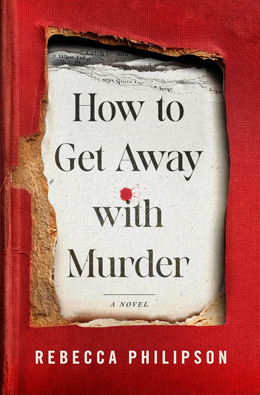
One of the key tenets of most crime fiction is justice—seeking justice, evading justice, or some combination of the two. There are books where justice is ultimately denied, but even in those cases, readers find a sense of comfort in the efforts made toward accountability. With that in mind, the title of Rebecca Philipson’s debut—How to Get Away with Murder—may initially be jarring, but it’s only after the book is open and read that its true subversive nature is understood.
One half of How to Get Away with Murder, is a fairly straight-forward traditional police procedural in which the authorities are looking for the killer of a young girl whose body was left leaning against a tree in a London park. In this girl’s hand, a book was discovered: How to Get Away with Murder by Denver Brady. By all accounts, it seems that Denver is an unknown serial killer who has been leaving bodies in his wake since the age of twelve. The book is an instruction manual intended to teach others how to evade justice.
There has long been an argument against crime fiction, this idea that it somehow encourages violence and/or helps criminals get away with their crimes. These arguments are largely easy to discredit, but there is no doubt that Rebecca Philipson has opened the door further on that debate—this fake memoir/self-help book (excerpts of which alternate with the ongoing investigation), does indeed provide practical information career criminals may find useful.
That said, few fans of the genre will be able to resist this gripping tale. Despite being the central point of view, Detective Inspector Samantha “Sam” Hansen, does a good job of keeping a distance between herself and the reader, but it’s to Rebecca Philipson’s credit that subtle shifts in that bond go unnoticed until ultimately Sam becomes one of crime fiction’s iconic leads. Part of this is because readers can relate to Sam’s mental state as the novel begins. She is a flawed character, but one who is always unapologetically herself.
As the current case and the murders from the self-help manual become intertwined, the hook on the reader becomes stronger. These are fascinating case studies and everyone—including Sam—can feel that the answers are just out of reach, in some shadowy haze, waiting to be discovered.
Readers will have moments where they doubt the novel’s ability to bring this home to a convincing conclusion and its third act is definitely handled in a unique way, but Rebecca Philipson knows what she is doing—ultimately leaving the reader wholly satisfied (albeit slightly sad that it’s over).
Debut novels this strong are rare and readers will be anxious to see what Rebecca Philipson will do next. Based on How to Get Away with Murder, it’s probably going to be something unlike anything we have seen before.
BUY LINKS: How to Get Away with Murder by Rebecca Philipson
Disclaimer: An e-galley of this title was provided to BOLO Books by the publisher. No promotion was promised and the above is an unbiased review of the novel.


