
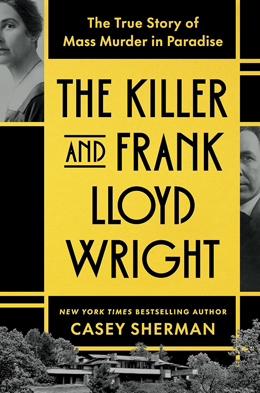
Casey Sherman’s The Killer and Frank Lloyd Wright is an excellent overview of the genius architect’s life for those interested in learning more about the man. The title of the book is a bit misleading, but as long as readers know what they are getting, this is only a minor annoyance.
The bulk of this non-fiction work unspools like a streamlined biography of Frank Lloyd Wright. Readers start by learning a bit about his ancestors before being introduced to his parents and then Frank himself. As with any story of Frank Lloyd Wright there is much talk about his various relationships: first his marriage to Kitty Tobin, then his affair with Mamah Borthwick, followed by his second marriage to Miriam Noel, before wrapping up with his final marriage to Olgivanna Lazolvic.
These discussions of his relationships with the women who surround him highlight the dichotomy within his life. On the surface, it may appear that he doesn’t respect women, but the truth—as it often is—is far more complicated. Frank Lloyd Wright is a troubled man and while having an affair is never the recommended route, this book documents his multiple attempts to divorce Kitty before embarking on the affair with Mamah—and Kitty’s refusal and negotiations where that dalliance is concerned. There is less of a detailed discussion of the later two relationships, so his moniker of being a “cad” may still be appropriate, albeit, not quite as cut and dried as often presented.
The Killer portion of the book’s title refers to Julian Carlton—an employee at Taliesin—who committed a mass murder and major arson on the property in 1914. Tragically, Mamah and her two youngest children from her first marriage were among the seven people killed with an ax on that day. Only a brief prologue and one chapter of The Killer and Frank Lloyd Wright is devoted to the murder/arson at Taliesin, so readers looking for more of a true crime exposé should look elsewhere. As such, the book’s subtitle, The True Story of Mass Murder in Paradise, comes across a bit like tabloid titillation meant to lure in readers, but it ultimately fails to deliver on that promise. Truth be told, since Carlton was quickly caught and never gave a reason for his actions, there’s very little information on which to base more than this brief section on this incident. That said, all evidence points to Frank Lloyd Wright’s devoted love of Mamah and the tragedy certainly altered the course of his life in profound ways.
As one might expect, there is much discussion of Frank Lloyd Wright’s financial situation, his mentorships, the commissions, and his legacy. Because he spent much time in Japan with Mamah, both his collection of Asian art prints and his building of a Tokyo hotel—which famously withstood one of the worst earthquakes in history and forever changed the way construction in earthquakes zones was approached—makes for a satisfying final section of the nonfiction work.
In the end, those readers looking for a general overview of Frank Lloyd Wright’s life—along with what few details there are about the only murder(s) that are connected to his history—will find much to enjoy in Casey Sherman’s The Killer and Frank Lloyd Wright.
BUY LINKS: The Killer and Frank Lloyd Wright by Casey Sherman


